The owner was the operating system.
Seth Falk built Hands On Exotics from one tortoise at a birthday party in 2011 into a business running more than 1,200 events a year.
Bookings came in by email and phone, schedules lived in spreadsheets, handler assignments went out by group text, and the safety rules for 40+ animals lived in Seth’s head. He was the operating system.
I mapped how the business ran, then built a public website, an admin dashboard, and a handler app on one shared system, with 13,000 past customers imported from QuickBooks.
- Client
- Hands On Exotics, animal events, Toronto
- What I built
- A public website, an admin dashboard, and a handler app, on one system
- Connected to
- QuickBooks, Stripe, and Google Calendar
-
1,200+
events a year
-
40+
animals, each with its own rules
-
13,000
past customers imported
-
1 click
from request to quote, was 24 to 48 hours
Built with
Code
- Next.js
- React
- TypeScript
- Tailwind CSS
Runs on
- Vercel
- Supabase
Connected to
- QuickBooks
- Stripe
- Google Calendar
- Google Maps
- Resend
- Google Analytics
Tested with
- Vitest
- Playwright
Also inside
- FullCalendar and dnd-kit The schedule, with drag and drop
- Dexie and next-pwa The handler app, working offline
- React Email and ical-generator The emails and their calendar invites
- TanStack Table and Recharts The dashboard’s tables and charts
- fast-check The property tests
- Turborepo One codebase for the three apps
The system
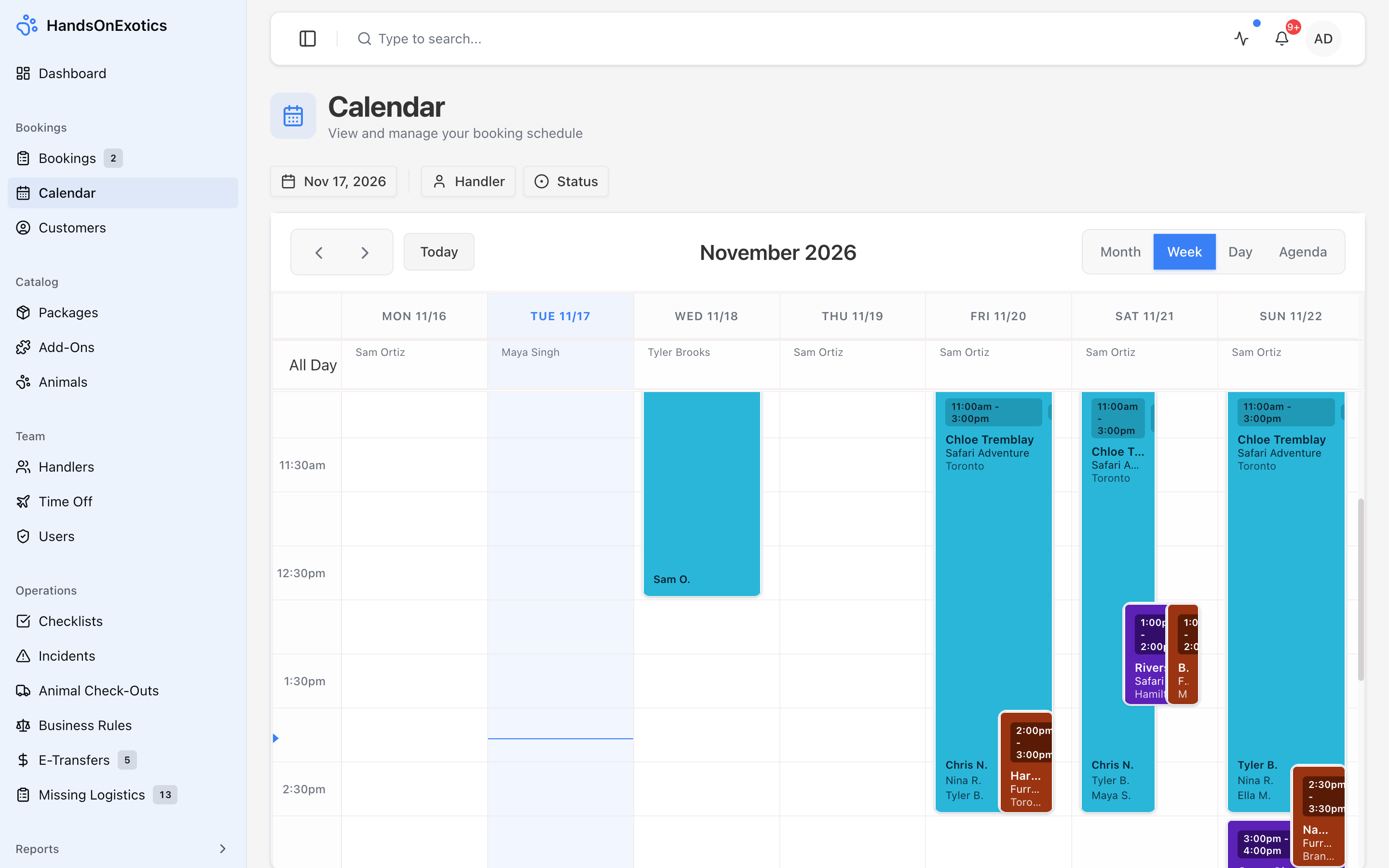
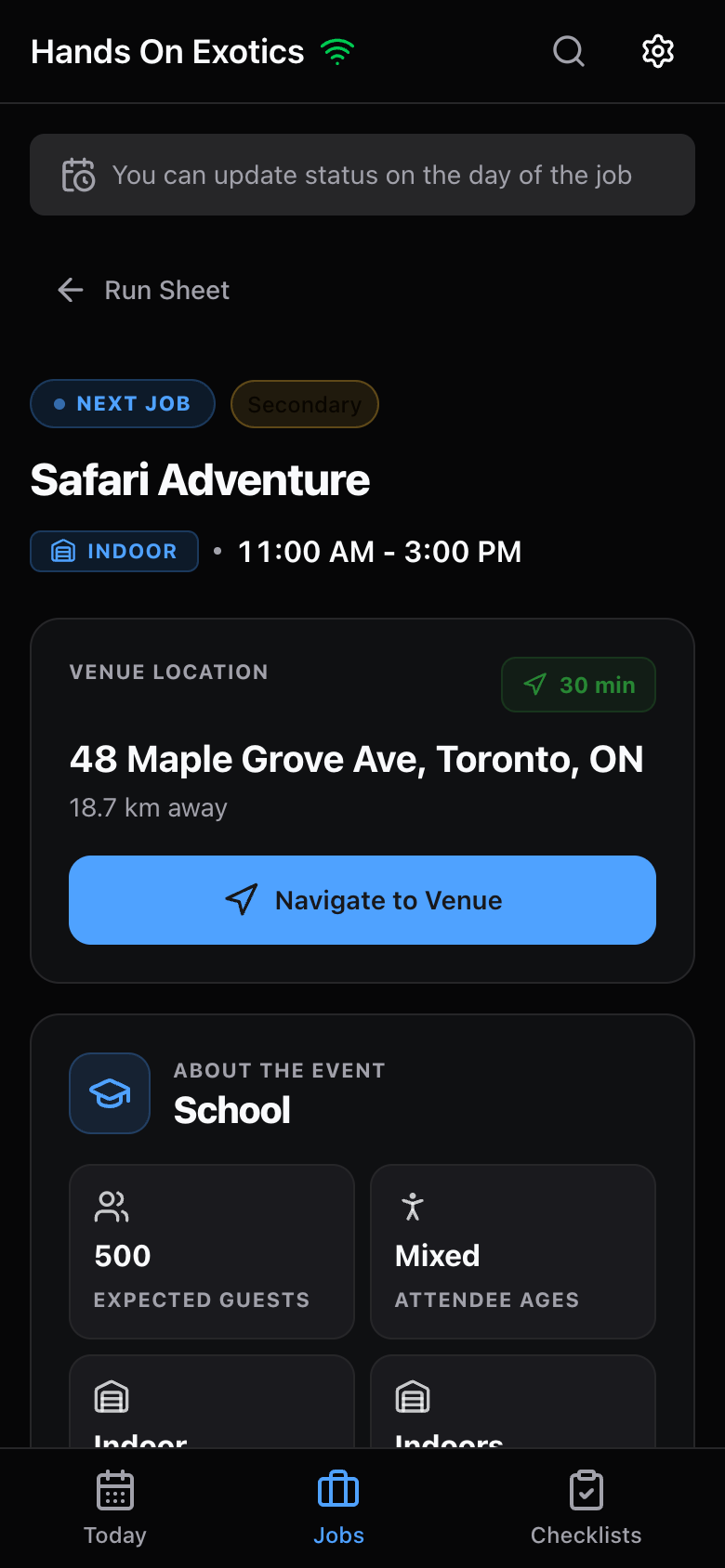
Three apps, one system.
A public website that takes the bookings, an admin dashboard that runs the operation, and an app for the handlers in the field. All three share one set of bookings, animals, and rules.

The story
Every rule lived in one head.
How it ran
Every booking went through Seth. A birthday party, a school visit, a film set: for each one, he worked out which animals were free, which handlers were cleared to take them, whether they’d fit in the van, and what the drive added to the price. Then he quoted it by hand.
Handlers found out which animals to load the morning of the show, by group text. Before every show, someone called to ask where to park. Invoices went out when someone got to them, sometimes weeks after the event.
What I built
I started by mapping how the business ran: every step from the first inquiry to the paid invoice, who did it, and where it waited on Seth. The rules were the hard part. Which handler can take which animal, how many shows in a row an animal can do, what can ride together in the van, what the weather rules out. I wrote each one down with Seth, then built them into the system.
The three apps sit on top of those rules. The 13,000 past customers in QuickBooks came across too, so the new system started with the whole history.
What changed
A booking request used to arrive as an email. Someone looked up the address, worked out the travel, checked which animals and handlers were free, built an invoice in QuickBooks and sent it by hand, 24 to 48 hours after the request came in. Now the request lands in the admin dashboard with the travel already worked out. Someone checks it and clicks Send quote. The customer reviews it online and pays by card or e-transfer, and the moment it’s paid, the system books the animals and the handlers and plans the day.
The rules moved out of Seth’s head and into the system, where they’re checked on every booking instead of remembered. A booking that would put a handler with an animal they aren’t cleared for, or an animal past its limit, is flagged before anyone confirms it.
Handlers see their day on their phones. Invoices sync to QuickBooks from the booking.
The quote
A quote used to take 24 to 48 hours. Now it’s one click.


Every busy season you hold together by hand costs more than the last one.
Take two weeks off. Come back to a business that kept running.
Book a free callA 30-minute call. I’ll tell you plainly where to start, or if it isn’t worth fixing.
Not ready to talk? Take the 4-minute scorecard.